Friends of the Library Special Heirloom Quilt Raffle
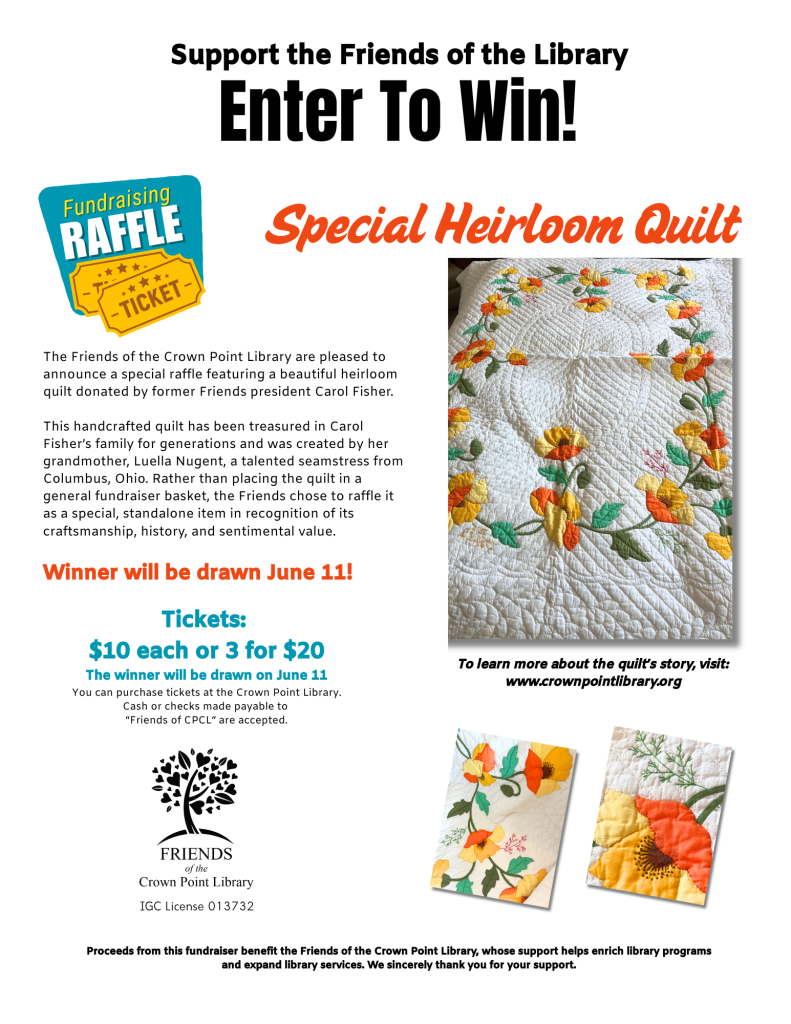
The Friends of the Crown Point Library invite the community to participate in a special raffle this May for a one-of-a-kind heirloom quilt generously donated by former Friends president Carol Fisher.
More than a beautiful handcrafted piece, this quilt carries a remarkable family story. It was created by Carol’s grandmother, Luella Nugent, who lived in Columbus, Ohio, and was known for her sewing and quilting talents. Luella worked as a seamstress and created quilts for her family, combining artistry with practicality during an era when handmade household items were cherished necessities.
Recognizing the quilt’s history and craftsmanship, the Friends selected it as a featured raffle prize all its own.
Tickets will be on sale from May 1 through June 11 for $10 each or three for $20. Tickets can be purchased at the Crown Point Community Library. Cash or checks made payable to the Friends of the Crown Point Library are accepted. The winning ticket will be drawn on Thursday, June 11.
Community members are encouraged to stop by the library to view the quilt, which is currently on display.
Proceeds from this fundraiser benefit the Friends of the Crown Point Library, whose support helps enrich library programs and services. We sincerely thank you for your support.
To learn more about the quilt’s story, Rose Kendall recently interviewed Carol and gathered what provenance the family could share.
Carol told Rose, “My grandmother, Luella, may have created it as a young mother—or possibly later in life, when she worked as a seamstress for a custom shirt tailor in Columbus, Ohio.”
As was typical of the period, one of the primary responsibilities for women keeping house was needlework. Luella’s first quilts were likely sewn by hand as she raised her young children.
As Grandma Luella’s skill as a textile artisan grew, she made additional quilts for her family. She also worked outside the home as a seamstress at a custom men’s retail shop, where she sewed shirts.
At one point, Luella considered leaving her job as a professional seamstress; balancing childcare and work outside the home had become too difficult. But the shop owner recognized the exceptional quality of her work and arranged an industrial sewing setup so she could continue making tailored shirts from home.
Ohio State University (OSU) documents the history of handmade garments in Columbus, Ohio.
The following excerpt provides helpful context:
Throughout much of the 19th century, up until the perfection of the sewing machine in the 1850s, clothing was predominantly custom-made to fit each
customer’s specific sizes. In 1852 Columbus city directory, William Burdell, a merchant in the city, was one of the first to advertise this “new way” of making clothing by machine, comparing it to recent and improved means of transportation, the railway, and the latest means of communication, the telegraph. New technology, along with the development of men’s sizing standards during the Civil War, which were a necessity
for the mass production of military uniforms, helped the ready-made clothing manufacturing industry grow and prosper. In Columbus, Simon Lazarus, who founded the S. Lazarus department store downtown in 1851, recognized that soldiers returning from the war would need civilian clothing. In order to capitalize on this demand and expand his business, he traveled to manufacturers in Rochester, New York and purchased a better class of ready-made merchandise. The Lazarus store would go on to become one of the most
successful and influential retailers in the Midwest, eventually merging with Macy’s in 2003.
The 19th-century industrial revolution made fabrics more readily available, and anyone working in the garment trade would have had a rich source of supplies for quilt making.
Carol reminisces, “As a teenager, I knew my grandmother was making quilts. Our family talked about Grandma’s ability to quilt. I remember visiting Columbus, where her grandparents spent their entire lives. Grandma kept her collection in dresser drawers—they were the household blankets, not ornamental crafts.”
So how did the quilt end up in Crown Point, Indiana?
Evelyn, Carol’s mother, attended a business college in Columbus, met and married Clarence Fisher, a chemical engineering graduate of nearby Ohio State. After the Great Ohio River Flood of 1937, Carol’s parents moved their young family to Pittsburgh, Pennsylvania. Following an industrial accident and with a new baby during the Depression era, the couple reconsidered their path. Clarence contacted a former professor, who suggested opportunities in Gary at U.S. Steel. Clarence was hired on the spot, and off to Northwest Indiana the Fisher family went.
Carol recalls, “My mom, also a good seamstress, would always hem her ‘short’ dad’s cuffs.” So, did the legacy of sewing pass on to Carol? Carol laughs at the thought: “Well, I’ve made a few scarves and things over the years to gift to others… but nothing compares to the beautiful needlework of my ancestors.”
When Grandma Luella passed away in 1973, her quilts were distributed among her children and, over time, to her grandchildren. Carol received several and donated this one to the Friends of the Crown Point Library Raffle.